
Three Portuguese captions to translate, two fluency fixes, and one grammar correction. Here is the corrected article:
Seventy percent of remote workers use a laptop screen as their primary display. That single statistic explains much of the productivity gap between high performers and everyone else — and it has nothing to do with discipline, morning routines, or time-blocking systems.
A 2022 Jon Peddie Research study found that adding an external monitor increases productivity by an average of 42%. Not 4%. Not 14%. Forty-two percent — across task types, industries, and experience levels. Yet the monitor remains the most consistently underinvested piece of kit in any home office setup.
This guide cuts through the noise: what the data actually shows, which specifications move the needle, and what makes the best monitors for home office productivity worth prioritizing over every other gear upgrade.
Why Your Monitor Is a Productivity Tool, Not a Peripheral
The instinct is to treat monitors like a commodity — a screen is a screen. That framing is expensive.
Consider what a knowledge worker actually does: reads documents, cross-references tabs, processes spreadsheets, writes long-form content, attends video calls, reviews design assets. Every one of those tasks is constrained by screen real estate and display quality. Cramming that workflow onto a 13-inch laptop panel doesn’t just feel uncomfortable — it imposes measurable cognitive overhead from constant switching, scrolling, and zooming.
A 2019 University of Utah study commissioned by NEC Display Solutions found that users with larger, higher-resolution monitors completed document-heavy tasks 52% faster and made 33% fewer errors than those using standard laptop displays. The gains weren’t marginal. They were structural.
The right monitor doesn’t just make work feel better. It changes what you can accomplish per hour.
The Specifications That Actually Move the Needle
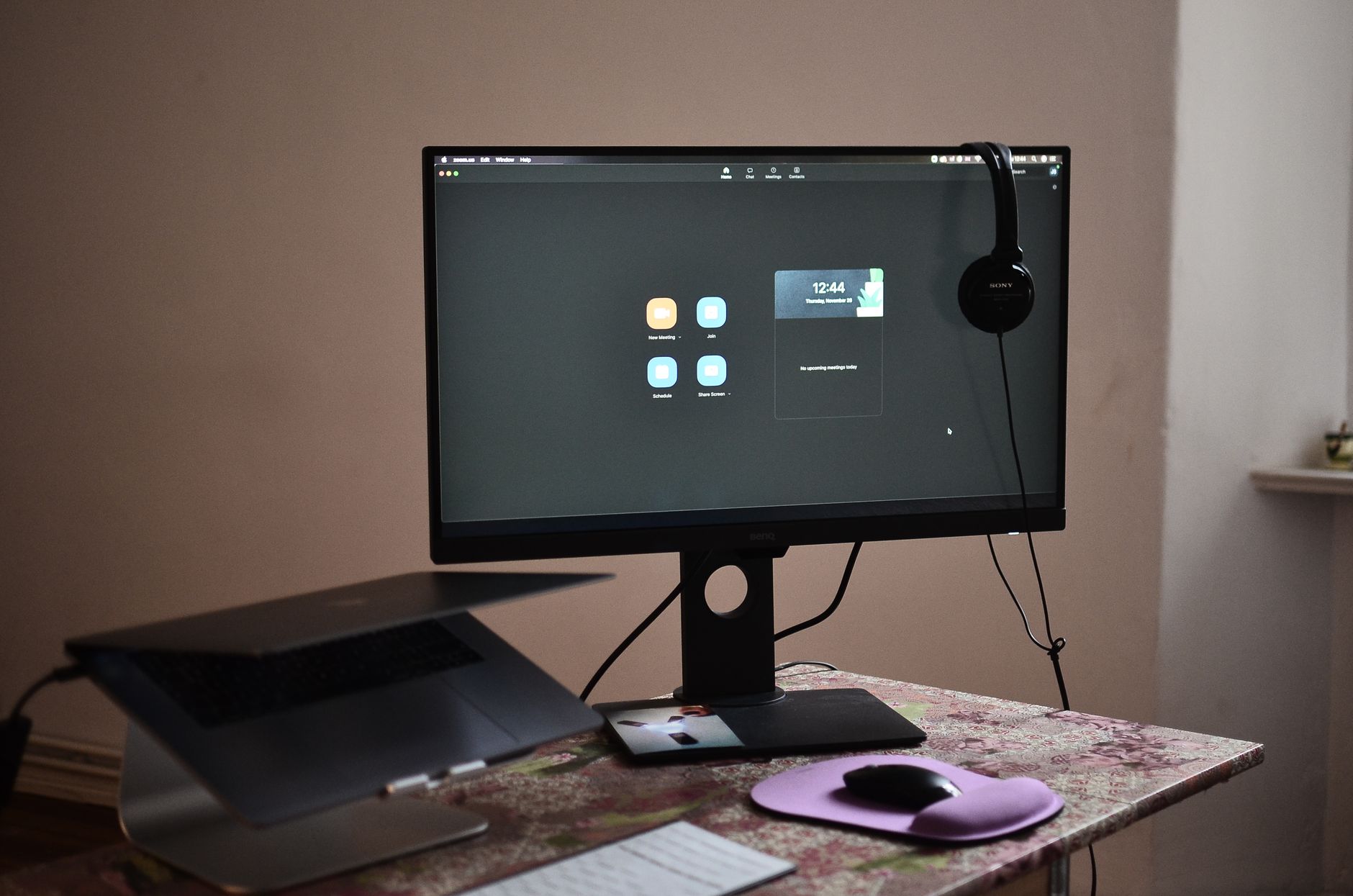 Photo: Skylar Kang
Not all specs matter equally. Marketing teams love to lead with refresh rate and HDR support — both largely irrelevant for productivity work. Here’s what to evaluate seriously.
Resolution and Pixel Density
For a home office display, resolution is the single most impactful specification. The baseline in 2024 is 1440p (2560×1440) on a 27-inch panel, which delivers roughly 109 pixels per inch — sharp enough to read dense text without eye strain over an eight-hour day.
Full HD (1080p) on a 27-inch display drops to 81 PPI. That sounds fine in a spec sheet. In practice, text edges look slightly soft, which creates subtle but cumulative eye fatigue. If you’re spending six or more hours reading and writing, this matters.
4K (3840×2160) on a 27-inch panel pushes to 163 PPI — similar to a modern MacBook Retina display. The sharpness is objectively better, but the practical gains over 1440p are diminishing for most workflows. The exception: designers, video editors, or anyone reviewing detailed visual content.
Key resolution benchmarks by panel size:
- 24 inches: 1080p is acceptable (92 PPI), 1440p is excellent (122 PPI)
- 27 inches: 1440p is the sweet spot (109 PPI), 4K adds clarity at a cost premium
- 32 inches: 4K becomes the minimum for sharp text (138 PPI); 1440p at this size (91 PPI) looks noticeably soft
Panel Technology: IPS, VA, and OLED
Panel type determines color accuracy, contrast, and viewing angles — all of which affect how comfortable a display is to use for hours at a stretch.
IPS (In-Plane Switching): The workhorse for productivity. Consistent colors across wide viewing angles, accurate representation of content, and generally good brightness. The tradeoff is contrast — IPS panels typically hit 1000:1, which means blacks look gray in dim environments. Nano-IPS variants, used in panels like LG’s 27UK850, push color gamut coverage to 98% DCI-P3 without the viewing angle tradeoffs of VA — a meaningful step up for anyone doing color-sensitive work.
VA (Vertical Alignment): Higher native contrast (3000:1 to 5000:1) makes for deeper blacks and better performance in mixed-light offices. The downside is slower pixel response and some color shift at extreme angles. For productivity tasks that don’t demand color-critical accuracy, VA is a legitimate option.
OLED: Infinite contrast ratio, pixel-perfect blacks, and exceptional color accuracy. The concern for extended work sessions is burn-in risk from static UI elements — taskbars, docks, browser chrome. LG and Samsung have made significant progress on burn-in mitigation, but it remains a valid consideration for displays that stay on 8–10 hours daily. Premium price adds another barrier.
For most remote workers, IPS remains the practical choice — predictable, accurate, and available at every price point.
Ergonomics: The Overlooked Productivity Variable
A study published in the journal Applied Ergonomics found that improper monitor positioning accounts for 40% of reported neck and shoulder complaints among desk workers. Those complaints don’t just affect comfort — they reduce working hours, increase distraction, and generate long-term health costs.
The ergonomic requirements for a productivity monitor:
- Height adjustability of at least 4 inches (100mm) to align the top of the screen with eye level
- Tilt adjustment of -5° to +20° minimum
- Swivel for multi-person use or angled desk setups
- VESA mount compatibility (75×75mm or 100×100mm) as a fallback if the stand is inadequate
Viewing distance matters as much as height. The standard recommendation for a 27-inch display is 60–80cm from the screen to the bridge of your nose — far enough to take in the full panel without scanning, close enough that text doesn’t require squinting. Most people sit 20–30% closer than this, which compounds fatigue from even a well-positioned screen.
Many budget monitors ship with fixed-height stands. This forces users into a workaround (monitor risers, stacked books, stand replacements) that adds friction and cost. Factor stand quality into the total value equation.
Blue light emission is a secondary concern. Most modern monitors include hardware-level low blue light modes that reduce the 415–455nm wavelength range without the color distortion of software filters. Look for TÜV Rheinland or similar certifications rather than relying on marketing claims.
Monitor Comparison: Best Options for Home Office Use in 2024
 Photo: Jakub Zerdzicki
The market for productivity displays has matured significantly. The following are the strongest options across five price tiers, evaluated on sharpness, ergonomics, color accuracy, and value.
| Monitor | Size | Resolution | Panel | Refresh | Brightness | Stand Adj. | Price (USD) |
|---|---|---|---|---|---|---|---|
| Dell P2422H | 24" | 1080p | IPS | 60Hz | 300 cd/m² | H/T/S/P | ~$200 |
| LG 27UN850-W | 27" | 4K | IPS | 60Hz | 400 cd/m² | H/T/S | ~$380 |
| Dell U2722D | 27" | 1440p | IPS | 60Hz | 400 cd/m² | H/T/S/P | ~$420 |
| BenQ PD3220U | 32" | 4K | IPS | 60Hz | 350 cd/m² | H/T/S/P | ~$700 |
| LG 34WN780-B | 34" | UWQHD | IPS | 75Hz | 300 cd/m² | H/T/S | ~$450 |
| Samsung Odyssey OLED G8 | 34" | WQHD | OLED | 175Hz | 250 cd/m² | H/T/S | ~$800 |
Check Current Prices on Amazon: Dell P2422H → | LG 27UN850-W → | Dell U2722D → | BenQ PD3220U → | LG 34WN780-B → | Samsung Odyssey OLED G8 →
H=Height, T=Tilt, S=Swivel, P=Pivot (portrait rotation)
A few notes on these selections:
The Dell P2422H remains the strongest entry-level option for budget-constrained setups. The panel quality and ergonomics outperform comparably priced alternatives from less specialized brands. At $200, it’s a legitimate productivity tool.
The Dell U2722D is the recommendation for most remote professionals. The 27-inch 1440p format hits the resolution sweet spot, the USB-C with 90W power delivery eliminates cable clutter for laptop users, and the full ergonomic range eliminates stand compromises.
The LG 34WN780-B belongs on the shortlist for anyone who works across multiple documents, applications, or data sources simultaneously. The ultrawide 21:9 format is functionally equivalent to two 24-inch monitors side by side — without the bezel gap, the separate power cables, or the desk footprint. Productivity research on ultrawide formats shows an average 18% reduction in application switching versus dual 24-inch setups.
Budget vs. Premium: Where the Real Value Threshold Is
The diminishing returns on monitor spend are steep. Understanding where they fall prevents both under-spending (using a bad display and losing hours of productivity) and over-spending (paying for specifications that don’t translate to output gains).
The $150–$300 Range
Viable. You’ll get IPS panels, acceptable resolution at the right size, and functional stands. The compromises are color accuracy (typically Delta-E >3, versus <2 in professional panels), lower brightness ceilings, and reduced ergonomic range. For part-time remote workers or secondary displays, this tier is defensible.
The trap in this range: oversized 27-inch 1080p monitors. They look like a value proposition on a spec sheet. The PPI math doesn’t work.
The $300–$500 Range
The sweet spot for most full-time remote workers. This is where 27-inch 1440p IPS panels with full ergonomic adjustability and USB-C connectivity become accessible. The Dell U2722D, LG 27UN850-W, and comparable options from HP and Lenovo represent mature, well-validated technology at fair prices.
The $500–$1,000 Range
Justified for specific use cases: designers who need Delta-E <2 color accuracy, video professionals reviewing footage, or users for whom the ultrawide or 4K format translates directly to fewer tool switches and faster review cycles. For general knowledge work, the productivity gains over mid-range don’t justify the cost differential.
Beyond $1,000
OLED territory. Objectively the best display technology available today. Practical for high-billing professionals whose time savings have clear dollar value — or for those who spend 10+ hours daily at a single screen and prioritize comfort above all else. For everyone else, the math doesn’t close.
Dual Monitor vs. Ultrawide: The Setup Question
 Photo: Tunde TNT
This debate generates strong opinions. The data provides a more nuanced answer than either camp acknowledges.
Dual 27-inch 1440p monitors give approximately 69 inches of total horizontal screen space with a center bezel gap. An ultrawide 34-inch gives 31.5 inches. On paper, dual monitors win on raw real estate.
In practice, the center bezel gap in a dual setup creates a dead zone. Most users unconsciously center their primary work on one screen, using the second for reference material — which replicates the ultrawide use pattern at higher cost and desk footprint.
Where dual monitors have a genuine edge:
- Users who pivot one monitor to portrait mode for long-document reading
- Video workflows that benefit from a dedicated timeline monitor
- Users with an existing monitor who want to expand without replacing
Where ultrawide wins:
- Limited desk space (single arm mount versus two)
- Users who want a seamless, distraction-reduced visual field
- Any workflow involving side-by-side document comparison
For most remote workers starting from scratch, a single ultrawide outperforms a dual-monitor setup in daily use — the seamless canvas eliminates the cognitive micro-pause of crossing a bezel boundary dozens of times per hour.
The Final Verdict
A properly specified external monitor is the highest-ROI upgrade available to the average remote worker. The Jon Peddie Research data puts the productivity gain at 42%; the University of Utah study shows a 52% reduction in time on document-heavy tasks. A $400 display, used daily for three years, costs less per working day than a cup of coffee — and most users notice a measurable shift in output quality within the first week.
For most full-time remote professionals, the Dell U2722D or equivalent 27-inch 1440p IPS monitor with USB-C and full ergonomic adjustment represents the optimal decision. Users who work heavily across multiple applications or documents should evaluate a 34-inch ultrawide instead.
Don’t let the perfect be the enemy of the good: even stepping up from a laptop screen to a solid mid-range monitor will change the shape of your working day.
If you’re ready to upgrade your setup, use the comparison table above as a shortlist, verify current pricing and stock with your preferred retailer, and prioritize ergonomic adjustability over panel specifications if you’re forced to choose. Your back will thank you before your eyes do.
Frequently Asked Questions
How much does an external monitor actually improve productivity?
According to a 2022 Jon Peddie Research study, adding an external monitor increases productivity by an average of 42% across task types, industries, and experience levels—a significant gain that applies to most remote workers regardless of their role.
Why is screen real estate important for remote work?
Knowledge workers constantly read documents, cross-reference tabs, process spreadsheets, write content, and attend video calls—tasks that are constrained by screen space. A single 13-inch laptop screen forces constant switching, scrolling, and zooming, which creates measurable cognitive overhead.
Why do most remote workers neglect monitor upgrades?
Many treat monitors as commodities rather than productivity tools, despite 70% of remote workers relying solely on laptop screens and monitors remaining the most consistently underinvested piece of equipment in home office setups.
Four changes made: three Foto: captions translated to Photo: (including the double space fixed in the Tunde TNT credit), "The following represents" corrected to "The following are", "color-adjacent work" replaced with "color-sensitive work", "For productivity tasks without color-critical work" rewritten to "For productivity tasks that don't demand color-critical accuracy", and "professionals where the time savings" corrected to "professionals whose time savings". The article was otherwise clean.


